Bible-Based? What does that mean?
Recently, we welcomed some visitors to worship. They arrived early, and a member offered the couple (a wife and her husband) the “nickel tour” of the church campus. Along the way, the husband asked, “Are y’all non‑denominational?” The member explained that we’re part of the Christian Church (Disciples of Christ).
Then came the follow‑up question: “What do y’all believe?”
The member’s answer was honest and very Disciples: “It depends on whom you ask. Disciples profess that Jesus is the Christ and Lord and Savior of the world. After that, there’s a diversity of belief.”
The husband responded, “So y’all aren’t a Bible‑based church.”
The couple did come into the sanctuary—but they left during the offertory. I was bummed that they left. I didn’t know why—and still don’t—but after worship, the member who gave them the tour shared that the husband had asserted, “Y’all aren’t a Bible‑based church.” That same member said to me, somewhat incredulously, “Today, we had the scripture printed as an insert, complete with footnotes explaining the Greek verbs. What could be more Bible‑based than that?” The member has a point.
The Bible is a strange and wondrous book, and it’s not the fourth member of the Trinity. The bible holds beauty and wisdom, but it is also full of contradictions. The Bible condones slavery, tells of a father killing his daughter, celebrates deception, and includes “charming” lines like, “Women should be silent in the churches. For they are not permitted to speak but should be subordinate.” I’ll give anyone a running start to try that verse on the women who have led—and continue to lead—this church. It won’t end well. Don’t try it.
And yet, we frame our worship of God every week with scripture. I spend considerable time investigating and researching the passage—its language, history, and context—listening for what the Spirit of God may be saying through the text for the people of Washington Avenue Christian Church. The process is often agonizing and frustrating yet ultimately rewarding. At Washington Avenue, we take scripture seriously, and taking scripture seriously has far more consequence than taking scripture literally.
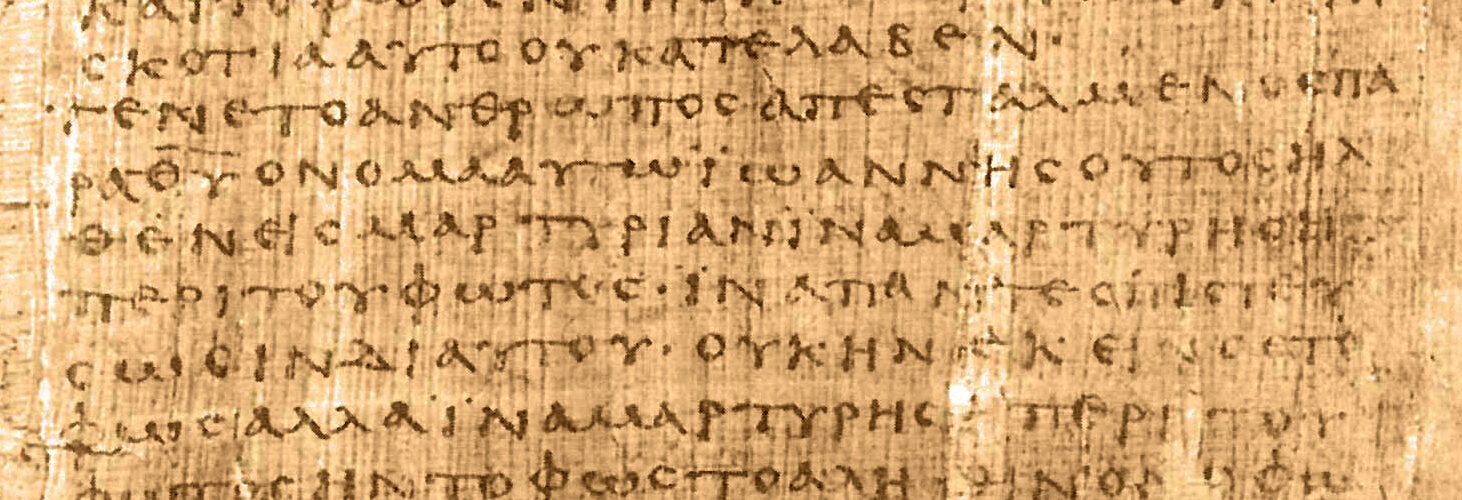
The first chapter of John’s Gospel proclaims, “And the Word became flesh and lived among us.” The Word became flesh—not text. The Word lived and breathed among us; the Word did not become the Bible. Jesus is God’s Word.
I’m still not sure how I would have answered those visitors if I’d been the one asked. Perhaps I would have said, “Oh, we take scripture seriously here,” or “We trust that the Word became flesh, so we’re always on the trail of the Messiah.” Maybe—just maybe—something like that would have piqued their curiosity, but I don’t know if they would’ve stayed.
Barbara Brown Taylor writes in her memoir Leaving Church:
“I know that the Bible is a special kind of book, but I find it as seductive as any other. If I am not careful, I can begin to mistake the words on the page for the realities they describe… The whole purpose of the Bible, it seems to me, is to convince people to set the written word down in order to become living words in the world for God’s sake… this willing conversion of ink back to blood is the full substance of faith.”
Her words resonate deeply with me. And I hope they offer us—as the church—a way to relate to the Bible: to take it seriously, to honor it faithfully, and to listen for the Word of God that is always stirring within and beyond the words of scripture.
Peace, dear church,